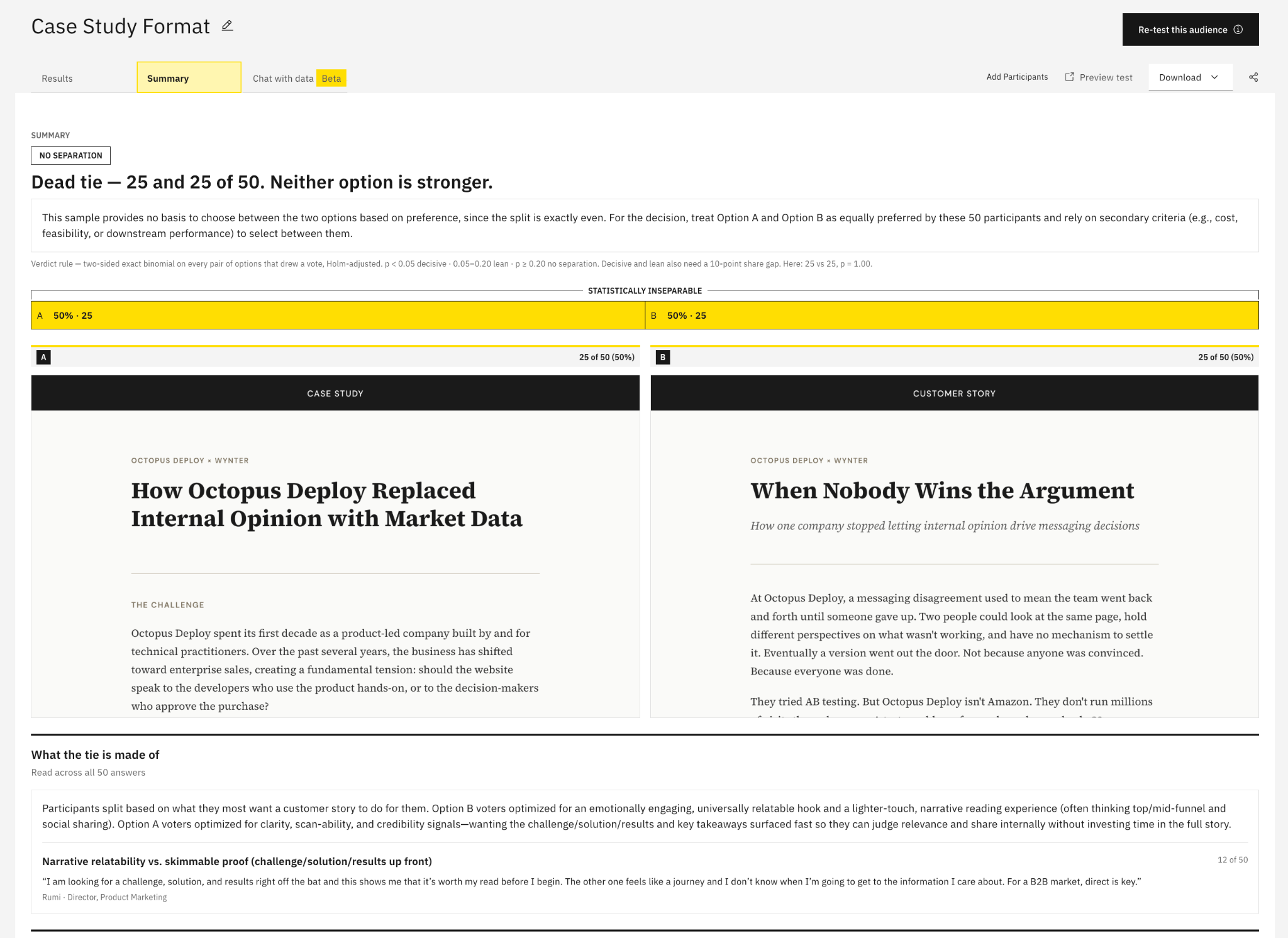
How the Summary helps you decide
1. Start with the strength of the result
The verdict is calculated deterministically outside the language model. AI does not decide whether a result is statistically significant.
2. See why people chose each option
The Summary groups the strongest reasons behind each option. Qualitative themes are tied to visible support counts and can include representative quotes, so you can trace the interpretation back to the responses.
3. See what held each option back
Recurring objections and reservations are surfaced alongside the positive reasons. That makes it easier to see whether the leading concept has a fixable weakness before you ship it.
4. Know when the evidence is too thin
If too few participants support a qualitative theme, the Summary keeps the language directional. Audience differences are shown only when minimum sample requirements are met. Otherwise Wynter explains why the comparison is withheld.
5. Get a next step that matches the evidence
Depending on the result, the Summary can point you toward shipping the supported option, addressing the main objection, collecting a larger sample, testing separate audiences, isolating an unresolved variable, or keeping the existing option when the alternative did not outperform it.
No clear winner is still a useful result
A Preference Test is not a failure when it returns No separation. It tells you that the evidence does not support choosing one option over another yet. The Summary then shows what participants still differed on and where the next test should focus.
No separation is a conclusion, not an error state.
Wynter will not turn the highest raw count into a winner when the statistical evidence does not support it.
What stays the same
The detailed option-level responses remain available below the Summary. The new layer helps you interpret the result faster without hiding the underlying evidence.
Start with the Summary
Open a completed Preference Test and start with the Summary before reading the detailed responses. Use the verdict to understand how much confidence the result supports, then use the reasons, objections and next step to decide what to do.