Brand Perception Survey: B2B Questions, Template and a Real Example
The exact questions, who to survey, how many people you need, and what a real brand perception study of 6 ABM platforms revealed.


Updated November 4, 2026
In 1986 I was 6 years old, living behind the Iron Curtain in Estonia. One day my dad came home with 2 bananas. I had never tasted one. My mom told me they were the best thing I'd ever eat: sweet, soft, delicious. They weren't ripe, so I had to wait days, staring at them.
When I finally took a bite, it was exactly as good as she said. I had zero opinion of bananas before. My mom shaped my perception that they were special, and then they were.
That's brand perception. It's not what your product is. It's what people believe about it before and after they use it. And in B2B, that belief decides whether you even get a shot.
Brand perception is what your target buyers believe about your brand: what you do, what you're good at, how you compare to alternatives, and whether you're for them. A brand perception survey measures those beliefs directly by asking people in your market, not your existing customers.
Three terms get mixed up, so let's separate them:
| Metric | The question it answers | How you measure it |
|---|---|---|
| Awareness | Do they know you exist? | Unaided and aided recall |
| Perception | What do they think you are and stand for? | Attribute association, distinctiveness, open text |
| Preference | Would they pick you? | Consideration and top preference |
You can have high awareness and bad perception (everyone knows you, nobody wants you). You can have great perception among the few who know you, and no awareness. A good survey measures all three, in order.
Most B2B brands have a more basic problem. As I wrote in 2025: "most people have no opinion about them whatsoever. Having any positive opinion in your buyer's mind is already a competitive advantage."
And when buyers do have an opinion, it's often years out of date. I have this problem myself. A lot of people still think of Wynter as just a message testing tool, because that's how we started, even though ICP research and brand surveys are now over 60% of our revenue. Your positioning changes. Your market's memory of you doesn't, because they don't think about you. Companies that expand their use cases are usually still perceived by their original one.
Most B2B marketers treat brand as a B2C thing. The data says the opposite.
The decision happens before you're in the room. In a Bain and Google survey of 1,208 US B2B buyers, 80% to 90% already had a "day-one" list of vendors before they started researching, and 90% ultimately bought from it (Harvard Business Review, 2022). In Wynter's 2026 survey of 101 B2B SaaS CMOs, buyers evaluated 3.3 vendors on average, and 79% said brand fame influences who makes their shortlist.
As I wrote back in 2024: "The selection happens without talking to sales. You losing the shortlisting battle will not show up in any report."
Most of your market isn't buying right now. Professor John Dawes at the Ehrenberg-Bass Institute estimates that up to 95% of B2B buyers are not in market at any given time (Dawes, May 2021). When the 5% wake up and start looking, they don't search from scratch. They start with the brands already in their heads.
Buyers don't shop around as much as they claim. Ehrenberg-Bass research on business banking found that 47% of B2B buyers who needed a new financial service went straight to their existing bank, and 75% of those who said they shopped around still ended up there. Most looked at only 2 brands.
Or as Brian Dean told me when I asked if he uses Ahrefs: "No, I use both of them." A category with 285 SEO tools, and he uses "both." We all know which other one he means. People have very limited consideration sets.
Products look the same to buyers. CEB and Google found that only 14% of B2B buyers see enough difference between suppliers to pay for it (From Promotion to Emotion, 2013). When products blur together, perception is the tiebreaker.
So brand perception isn't a vanity metric. It's a leading indicator of whether you make the Day 1 list.
Order matters. Ask unaided questions before you show any brand names, or you contaminate the answers.
Finish with one segmenting question: are they using a product in the category now, evaluating one, or not in market? You'll see why below.
If you sell into several use cases, add one more measure: category entry points. For each of your 5 to 10 buying situations, ask "When [situation] happens, which brands come to mind?" As I wrote in 2025: "If you're only linked to one use case, you're invisible in the other 9." "When X happens, who comes to mind?" is the brand metric that predicts revenue best.
Here's the full question set we use for brand tracking at Wynter, in order:
Two rules for the attribute list. First, use attributes buyers decide on, not the ones in your positioning deck. If you don't know what those are, run a short survey asking buyers what matters most when choosing a [category] vendor before you build the tracker. Second, keep the wording neutral. "Best-in-class AI" is a leading attribute. "Quality of AI features" isn't.
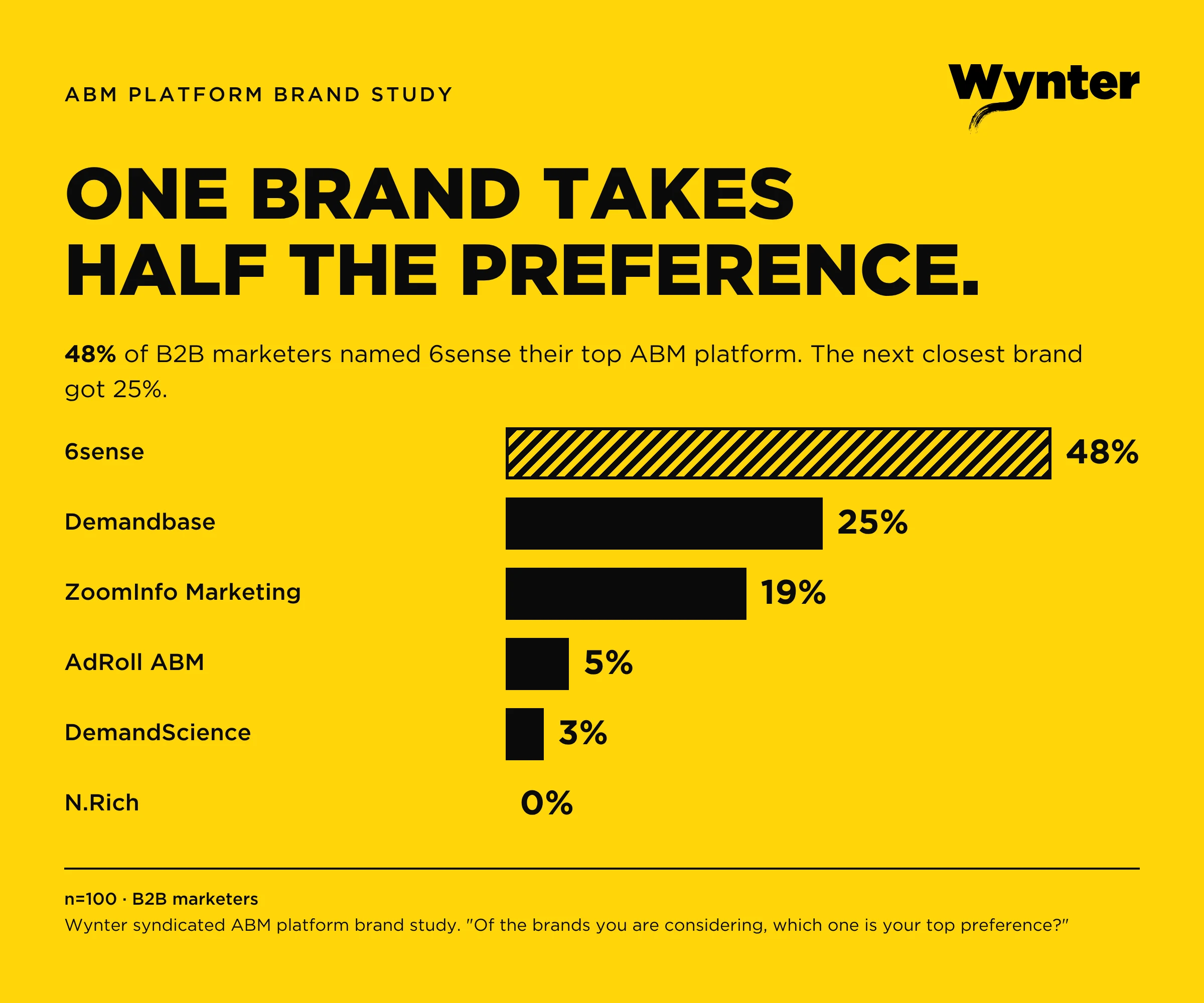
We ran this exact survey in Wynter's syndicated ABM platform study: 100 B2B marketers, 6 brands. Here are the headline numbers:
| Brand | Familiar (somewhat or very) | Would consider (probably or definitely) | Top preference | Most distinct |
|---|---|---|---|---|
| 6sense | 94% | 68% | 48% | 58% |
| Demandbase | 84% | 56% | 25% | 15% |
| ZoomInfo Marketing | 77% | 39% | 19% | 15% |
| AdRoll ABM | 60% | 27% | 5% | 5% |
| DemandScience | 63% | 23% | 3% | 4% |
| N.Rich | 8% | 5% | 0% | 3% |
Four lessons from this one study.
1. Two brands own the same attribute, and the leader wins it. 77% of respondents associate 6sense with high-quality intent data. 60% say the same about Demandbase. When the challenger's main perceived strength is also the leader's, buyers default to the leader. The double jeopardy law in action: small brands get punished twice, with fewer buyers who also buy less.
2. You can see the white space. No brand owns "high value for money" (11% at most) or "ease of setup and fast time to value" (27% at most). That's an open positioning lane for anyone in the category willing to claim it and prove it.
3. Awareness without perception is worthless. DemandScience (formerly Terminus) is familiar to 63% of respondents, but 57% couldn't associate it with a single attribute. People know the name and don't know what it stands for. That's often what a rebrand costs you.
4. Check who you're surveying. 64% of respondents already pay for one of these platforms. If you don't separate current users from people in market, you're mostly measuring the installed base, and the market leader's numbers get inflated by its customer count.
The same pattern shows up in other categories. In a Wynter brand tracking study of marketing automation platforms with mid-market B2B SaaS buyers, about half named HubSpot, Adobe Marketo or Pardot when asked which brands come to mind first. Everyone else got 10% or single digits. HubSpot was a top choice for 56%, Marketo for 42%, Pardot for 28%, and no challenger reached 10%. Challengers like Braze, ActiveCampaign and Customer.io had 55% to 70% aided awareness, so buyers knew them. They just didn't think of them first. The big brands take the first 3 spots on the shortlist before the buying process even starts.
With 100 respondents, your margin of error is about ±10% at 95% confidence. That number decides which differences are real.
In the ABM study, 6sense vs Demandbase on top preference (48% vs 25%) is a real gap. Demandbase vs ZoomInfo (25% vs 19%) is inside the margin. If you were Demandbase, you shouldn't celebrate that lead.
| Sample size | Margin of error (95% confidence) | Good for |
|---|---|---|
| 50 | about ±14% | Directional read, early-stage brands |
| 100 | about ±10% | Standard brand tracker |
| 200 | about ±7% | Tracking smaller changes over time |
| 400 | about ±5% | Segment-level cuts (by role, company size) |
If you want to compare segments (directors vs C-suite, say), each segment needs its own adequate sample. A 100-person study split 4 ways gives you 4 directional reads, not 4 trackers.
Survey your market, not your customers. Your customers already chose you. Their perception tells you why you won, not why you're losing.
Target the people who build the shortlist, not just the people who sign. As I wrote in 2026: "A lot of companies who do brand tracking only wanna survey VPs and C-level folks, which is a mistake." It costs more and respondents are harder to find. More importantly, "in most cases it's the manager-level folks who actually build the shortlist for tools." And since brand is a long game, include directors, who are likely to become the final decision-makers in the next 2 to 3 years.
The buying group is bigger than you think, too. In Wynter's 2026 CMO survey, the average buying committee was 5.1 people. Your sales team talks to 1 or 2 of them. The rest form their opinions from your website, what peers said in Slack, G2 reviews and what LLMs recommended. A brand perception survey is the only way to hear from them.
Use verified B2B respondents matched to your ICP: job title, seniority, company size, industry. General consumer panels can't reliably find a VP of RevOps at a 500-person SaaS company.
Maxio was born from the merger of Chargify and SaaSOptics. About 2 years in, Andrea Wunderlich wanted to know: had the market learned the new name? When can we stop saying "formerly Chargify"?
Traditional B2B research agencies quoted $100k to $240k and 6 months. She ran it on Wynter in 2 days, and ran it again a year later to measure the change.
The result: both Chargify and SaaSOptics still had higher unaided awareness than Maxio. So they slowed down. They launched a brand campaign and put the legacy names on all their 2024 trade show booths, using the old brands' equity to build the new one.
When you don't know how well the market knows your brand, don't guess. Measure it.
Run it once as a baseline, then on a fixed schedule with the same questions, the same audience definition and the same sample size. Changing any of the three breaks the comparison.
This is also how you defend brand budget. In Marketing Week's 2025 State of B2B Marketing survey of 450 B2B marketers, 50.7% said brand building isn't a priority, and 58.3% said brand isn't seen as delivering ROI. And in a 2025 Wynter survey of B2B marketing leaders, only 13% ran regular brand tracking surveys, while 33% tracked share of search alone, which tells you about today's demand, not tomorrow's shortlists.
My take: "you're never gonna attribute a brand campaign to a closed deal. Track perception instead." Ask 100 to 200 buyers in your category every 6 months whether they know you exist, whether they can say what you actually do, whether they'd shortlist you, and who comes to mind first. Then watch the numbers move: unaided awareness from 12% to 19%, say, or buyers who correctly describe what you sell from 30% to 44%. "That's a trend line you can put next to spend."
One honest caveat: a full brand tracker only makes sense once you're investing meaningfully in brand and have roughly 10% share or more in your category. Below that, most respondents won't know you, your numbers will sit near zero, and you'll learn little. Early-stage companies get more from message testing and positioning research first.
| Method | What it tells you | Limitation |
|---|---|---|
| Brand perception survey | What the market believes, quantified | Needs enough awareness to measure |
| Customer interviews | Why customers chose you | Survivorship bias: only the people who said yes |
| Social listening | What vocal people say | Most buyers never post |
| Win-loss analysis | Why specific deals went your way or not | Only covers deals you knew about |
| Message testing | How your messaging lands | Measures your words, not your brand |
They work together. The survey tells you where you stand. Message testing tells you what to say to move it.
A fair counterpoint before you build your attribute list. Jenni Romaniuk, Byron Sharp and Andrew Ehrenberg studied 17 categories and found most buyers didn't see their own brand as different or unique, yet bought it anyway (Australasian Marketing Journal, 2007). Their argument: being distinctive (easy to recognize, hard to confuse) matters more than being perceived as different.
I agree with half of that. Without strong distinctiveness, you get confused with your competitors, and small brands' ads get credited to big brands. But in B2B, buyers narrow to 3 by asking "how is X different from Y?" So measure both: distinctiveness (question 6) and what you're known for (question 7).
The template has 6 tabs: the 9 survey questions in order, an attribute list builder that flags which attributes to keep, a results calculator (percentages, consider-to-preference conversion and margin of error), an attribute map that shows who owns what, and a gap checker that tells you whether a difference between two brands is real. The ABM study above is pre-filled as an example. Download the free template (.xlsx)
If you'd rather not build the panel yourself, Wynter's brand tracking runs this survey with verified B2B buyers in your ICP, with results in days, not months.
What is a brand perception survey? A brand perception survey asks people in your target market what they know and believe about your brand and your competitors: awareness, consideration, preference, distinctiveness and the attributes they associate with each brand.
How do you measure brand perception? Ask unaided recall first, then aided familiarity, consideration, top preference, distinctiveness and attribute association, in that order. Survey your target market, not just customers, and use at least 100 respondents for a reliable read.
What questions should a brand perception survey include? At minimum: which brands come to mind for the category, how familiar they are with each brand, how likely they are to consider each, which they prefer and why, which stands out as most different, and which attributes they associate with each.
How many respondents do you need? 100 gives a margin of error of about ±10%, which is the standard for a B2B brand tracker. Use 200 or more if you need to compare segments or detect small changes over time.
How is brand perception different from brand awareness? Awareness is whether people know you exist. Perception is what they believe about you. You need both: awareness gets you considered, perception gets you chosen.
How often should you run a brand perception survey? Once a year for most B2B companies, every 6 months if you invest heavily in brand, and before and after a rebrand. Keep questions, audience and sample size identical between waves.
Competitive analysis template · Concept testing in B2B · Voice of the customer for B2B · B2B buyer personas · Copy testing