Voice of the Customer (VoC): A B2B Guide With Real Data
What voice of the customer means for B2B marketers, how to run it, how to turn it into messaging, and the blind spot most VoC programs miss.


Updated November 4, 2026
Most voice of the customer guides are written by CX platforms for support teams. They're about NPS dashboards and ticket tagging.
This one is for B2B marketers. You want VoC for a different reason: to know what to say, to whom, and why they should pick you. That changes which methods matter, which questions to ask, and who you should be asking.
Voice of the customer (VoC) is the process of capturing what customers need, want, expect and dislike, in their own words, and using it to shape product, messaging and experience decisions. In B2B marketing, VoC is the raw material for positioning and messaging: the pains, triggers, alternatives and language your customers use.
The term comes from Abbie Griffin and John Hauser's work at MIT, published as "The Voice of the Customer" in Marketing Science in 1993. Their study showed that 20 to 30 interviews uncover roughly 90% of customer needs in a category. That finding still holds up, and it's the reason good VoC doesn't need huge samples.
The best argument I know came from Patrick Campbell on a ProfitWell podcast. Companies that do customer research at least quarterly have higher willingness to pay, more efficient funnels, much higher LTV to CAC, and typically grow 15% to 20% faster than everyone else. Yet only 1 in 5 companies have buyer personas or ICPs, and only 1 in 10 do customer research quarterly or more.
Why so few? As I wrote in 2023: "Everyone knows they should be talking to more target customers, but most don't. Why? It's considerable pain in the ass to do. It's scary to reach out to people, it's painful to follow up, it's hard to find mutually convenient times."
The payoff is lopsided. If you invest 1% of your go-to-market budget into insights, it makes the other 99% go much further. The quality of your decisions comes from the quality of your information.
I saw this play out with a VP of product marketing at a $1B+ company. Her PMM team went from 30 people to 8. You'd expect the function to shrink in influence too. The opposite happened: product marketing became seen as strategic, because the team became the voice of the ICP inside the company. She credited AI for productivity and fast ICP insights for the rest: "We used to use market research agencies. Now if I would tell the team it'd take 2 months to get the results, I'd be laughed out of the room."
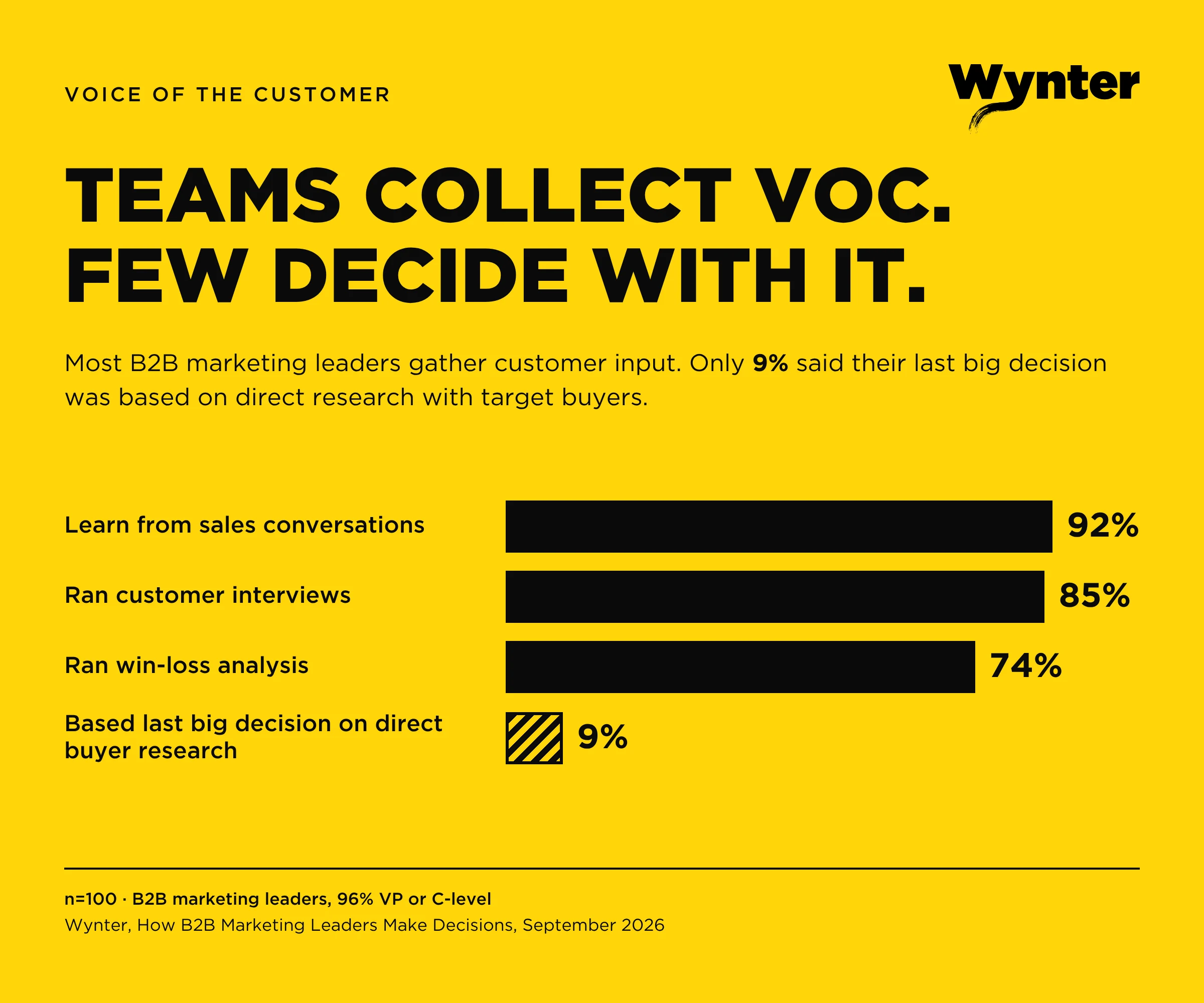
We surveyed 100 B2B marketing leaders (96% VP or C-level) for Wynter's How B2B Marketing Leaders Make Decisions (September 2026). Most teams are collecting VoC:
| VoC activity | Share of marketing leaders doing it |
|---|---|
| Learning from sales conversations | 92% |
| Customer interviews | 85% |
| Win-loss analysis | 74% |
But here's the gap. When we asked what their last big decision was based on, only 9% named direct research with target buyers. 32% called it a gut or leadership call. And 53% research non-customers once a year or less.
So VoC is being collected. It's just not driving decisions, and it's almost all coming from one group: people who already bought.
| Method | What it tells you | Sample | Cost | Cadence |
|---|---|---|---|---|
| Customer interviews | Why they bought, the trigger, the alternatives they considered, their words | 10 to 15 per segment | Time-heavy | Quarterly |
| Win-loss analysis | Why specific deals were won or lost | 10 to 20 deals | Medium | Ongoing |
| Sales call mining | Objections and questions, in the buyer's words | 20+ calls | Low if you record calls | Monthly |
| Review mining | What customers praise and complain about, in public | 50+ reviews | Low | Twice a year |
| Customer surveys | How common a pain or preference is | 50 to 100+ | Low | Twice a year |
| Customer advisory board | Strategic direction from your best accounts | 8 to 12 people | High | Quarterly |
For a step-by-step on mining reviews, support tickets and call recordings, see collecting voice of customer data from existing sources. For the full research playbook, see our guide to B2B customer research.
For qualitative methods, the principle is saturation: the point where new interviews stop producing new themes. A review of 23 empirical studies found that 9 to 17 interviews usually reach saturation with a focused question and a similar audience (Hennink and Kaiser, Social Science & Medicine, 2022). As I've said for years, the big sample size part is a myth. Spend the extra budget on more studies, not more participants.
And don't overcomplicate it early on. A B2B startup will get 10x the insights running live chat, message tests and sales calls compared to any quant data. You'll actually know what to do with the answers.
1. Start from a decision. "Should we rewrite the homepage?" "Which segment should we focus on?" VoC without a decision becomes a slide deck nobody reads.
2. Pick 2 or 3 methods, not 6. Most marketing teams should run customer interviews, mine sales calls, and mine reviews. Add win-loss if sales will give you access. And don't skip churned customers. In Wynter's 2026 competitive intelligence study, one PMM called them "the most underused source by far. They'll tell you exactly why they left."
3. Ask about the past, not the future. "Walk me through the day you decided to look for a tool like ours" gets you real answers. "Would you pay more for X?" gets you guesses.
4. Record and transcribe everything. You want verbatims, not your summary of what they meant.
5. Code the answers into themes. Pains, triggers, alternatives, desired outcomes, objections, language. Count how often each comes up.
6. Turn themes into messaging decisions (more on this below).
7. Repeat quarterly. Markets move. What your buyers cared about a year ago may not be what they care about now.
Pains and triggers
1. What was happening in your business when you started looking for a solution like ours?
2. What were you using before? What made it stop being good enough?
3. What would have happened if you hadn't solved this?
Alternatives
4. What other options did you look at, including doing nothing?
5. How did you build your shortlist?
6. Why did you rule out the others?
Decision
7. Who else was involved in the decision, and what did each of them care about?
8. What almost stopped you from buying?
9. What made you confident enough to sign?
Value and outcomes
10. What's the biggest difference you've seen since you started using it?
11. How do you describe what we do to a colleague?
12. If we disappeared tomorrow, what would you use instead?
Language and perception
13. What words would you use to describe the problem we solve?
14. What's one thing our website or sales team got wrong about you?
15. What do you wish you'd known before buying?
Question 7 matters more than most teams realize. Forrester's State of Business Buying, 2026 found the typical B2B purchase involves 13 internal stakeholders and 9 external influencers. Your champion's reasons aren't the only reasons.
The point of VoC for marketers is to change what you say. Here's the process:
For worked examples, see how to use voice of customer data to write copy for technical buyers.
When Elliot Roazen joined Platter as head of marketing, prospects were showing up to sales calls confused about the value proposition. He ran a message test on the homepage with ecommerce directors from the Shopify ecosystem. They found the messaging fluffy, didn't understand how Platter was a valid alternative to existing solutions, and wanted to see more of the actual product. Those were exactly the things to fix, in the buyers' words.
But messaging is only the start. As I wrote in 2024: "ICP research is not an exercise to get voice of the customer data for copywriting. A winning GTM requires a full recalibration." The same findings should change demand gen targeting (the communities and newsletters your ICP actually reads), the product roadmap, sales enablement and objection handling, the sales process, content, and customer marketing.
Here's what most VoC guides won't tell you.
Talking to customers is survivorship bias. Don't get me wrong, keep doing it. But your customers are the slice of the market that already said yes. They bought despite your messaging, your pricing, your missing features. Their answers explain why you won. They can't explain why the rest of your market never shortlisted you.
Here's how it usually goes, as I wrote in 2025: "Sales talks to the loudest prospects. Marketing surveys existing customers who already love you. Leadership makes decisions based on whoever spoke up in the last meeting." Meanwhile, 90% of your market, the people who've never heard of you, think something completely different about your category. And those answers keep moving. What worked 18 months ago doesn't work today. AI messaging used to increase signups; now it triggers eye-rolls.
And that's where most of your growth is. Most of your future revenue will come from future customers.
R. Eric Reidenbach made this argument in Listening to the Voice of the Market (2009): companies that only listen to current customers miss the market they're trying to win. He called the wider view Voice of the Market.
I think about it this way: VoC explains your past. Voice of Market (VoM) explains your future.
| Voice of the Customer | Voice of the Market | |
|---|---|---|
| Who | Your current customers | Your ICP, including people who never bought from you |
| Tells you | Why you won, what customers value, how to retain them | Why you're not shortlisted, how you're perceived vs alternatives, what the market wants |
| Bias | Survivorship: only people who said yes | None toward you; they owe you nothing |
| Methods | Interviews, win-loss, reviews, CS data | ICP surveys, message tests, preference tests, brand perception surveys |
This isn't either/or. You're already doing Voice of Customer. Add Voice of Market. Same questions, different people.
It matters because buyers decide before they talk to you. In Wynter's B2B Vendor Differentiation Survey, 87% of buyers built their shortlist from peer recommendations. And in Wynter's 2026 survey of 101 B2B SaaS CMOs, 80% arrived at sales calls already moderately or very familiar with the vendor, up from 64% a year earlier. The "very familiar" group more than doubled, from 22% to 48%. One CMO: "I never go into a demo blind anymore. I've already done my homework. The demo is just to confirm what I think I know."
If your messaging only reflects what customers love after onboarding, it may not be what gets you onto the list in the first place.
VoC can push you toward a vanilla product. Imagine doing customer research for IKEA. You'd hear about understaffed stores, impossible-to-find parts, terrible assembly instructions, loading boxes into your car, furniture that doesn't last. If IKEA fixed all of it, it would lose the thing that makes it IKEA: affordable, good-looking furniture that starts with the price.
As I wrote about it: "I'm not advocating for 'don't do research'. I've been a champion of research for a decade. I'm saying be brand-first. Be deliberate in your strategic trade-offs. Filter all research through your brand lens."
VoC is input to your strategy, not a replacement for it.
When VoC gets collected, then ignored. In our survey of 100 product marketers, a senior PMM at an enterprise SaaS company described leadership "chasing the hot new thing" while the product fell behind on "base features and integrations that VOC have been screaming for for five years." Their summary: "let's double down on AI then marvel at why our win/loss interviews show no change at all." That's the 9% problem from earlier in one sentence. The VoC exists. The decisions don't use it.
When ICP research beat personalization. A Fortune 500 company had separate homepage versions for enterprise, SMB, government and military buyers. ICP research led to a near-full rewrite of the homepage message. We tested that one version against the original and against every personalized version, and the single message won in every segment. The research showed which few differences between segments actually mattered, and most didn't.
When the market corrected a category bet. A software composition analysis company's leadership team was split on whether to reposition around an emerging category. They ran a message test, a preference test and a survey with their ICP on Wynter. The data showed it was a use case, not a category, and a category-level headline would have confused most of their buyers. It took 2 weeks, and the internal argument ended when the results came in.
When the market hadn't learned the new name. Two years after Chargify and SaaSOptics merged into Maxio, Andrea Wunderlich ran an aided and unaided awareness survey with their ICP. Both legacy brands still had higher unaided awareness than Maxio. So they kept the old names on their 2024 trade show booths, ran a brand campaign, and set a date to re-measure.
Notice that 3 of the 4 came from buyers who weren't customers yet. That's Voice of Market in practice: same discipline, wider audience.
What is voice of the customer? Voice of the customer is the process of capturing customers' needs, expectations and frustrations in their own words, then using that to make product, messaging and experience decisions.
What are examples of voice of the customer methods? Customer interviews, win-loss analysis, sales call analysis, review mining, customer surveys and customer advisory boards.
How many customer interviews do you need for VoC? Usually 9 to 17 per segment to reach saturation, the point where new interviews stop revealing new themes. Griffin and Hauser found 20 to 30 interviews uncover about 90% of needs.
What is a VoC program? A VoC program is a repeatable process, usually quarterly, for collecting customer feedback, analyzing it into themes, and routing the findings to the teams that make decisions.
What's the difference between voice of the customer and voice of the market? Voice of the customer captures what your current customers think. Voice of the market captures what your whole target market thinks, including people who have never bought from you. You need both.
How do you analyze voice of the customer data? Transcribe interviews, code responses into themes (pains, triggers, alternatives, outcomes, objections, language), count how often each theme appears, and rank them to build your messaging hierarchy.
Brand perception survey · Competitive analysis template · Concept testing in B2B · B2B buyer personas · Copy testing